
Ley Lines Issue #9: Alternate Histories, Possible Futures

Greetings, Wanderer.
Welcome back to Ley Lines, a regular series of miscellaneous things that I come across that interest, inspire, or intrigue me. Writing these posts is part of an active of being a more conscious consumer of what I read or observe, and is also just ongoing practice of writing and sharing. It’s a bit of a follow up to the “100 Interesting Things” series I wrote last year, and is inspired by Russel Davies’ book Notice, Collect, Share.
#1 The Lost Welsh Colony Of Y Wladfa A really good friend of mine is Welsh and in order to add a bit more colour to our banter I did some digging into Welsh politics and culture I found the story of Y Wladfa.
Apparently, a group of Welsh folk hopped on a boat in the 1800s and sailed all the way to Patagonian Argentina, where they and other people of European descent settled. They built homes, villages, communities, and in some cases both integrated with what was already there and kept a lot of their own culture.
What’s even more interesting about this story is that they were largely forgotten by Welsh history until the Falklands War of 1982. A number of Argentinians were captured by the British Navy, who were surprise to hear a few of their captives speaking a Welsh dialect.
As a result, the people of Y Wladfa reestablished contact with Wales proper.
This is some real lost colony stuff, and relatively recent history.
#2 The Palissy Nationalist Hockey Mask There is a section in a David Mamet essay about drama where he talks about magic, and the the suspension of belief needed for it to happen:
“Now of course the magician didn’t make that duck disappear. What he did was something of much greater worth—he gave a moment of joy and astonishment to some who were delighted by it. In suspending their disbelief—in suspending their reason, if you will—for a moment, the viewers were rewarded.”
I think we need to suspend that belief for us to enjoy drama in stories, for magic to 'happen’, but also for the sort of world-building and storytelling needed for a good bit of sci-fi or fantasy.
An example of this is the website for LMX Unlimited, a near-perfect piece of alternate history fiction told in the form of product descriptions for replicas of items available for purchase.
Some of the products (and associated “history lessons”) on the site include:
The 1993 Palissy Nationalist Hockey Mask (pictured below), whose description tells the story of how this iconic mask worn in the 1993 continental series helped unite the country and derail the NAFTA before it could be formed.
The 2057 Canadian Union Flag Hat, which has on the flag of the Assembly of Canadian Unions, a group of nations made up of not just Canada but a number of other European countries. The descriptions suggest that many of these countries renamed (or rename?) their capital city to be Ottawa as part of being a member country.
The 1753 Lundberg Crown, the symbol of authority worn by committee members who founded the first republic in North America.
None of these events actually happened, nor did these artefacts actually exist. What’s delightful about them is how close to existing they actually are for anyone who grew up studying Canadian history. The language, the phrasing, the timing, the and general sense of place in each of these write-ups feels so uncannily real that, to paraphrase Mamet above, we are left with a bit of joy. In the same way we enjoy wondering about the world beyond Frodo’s shire, Holmesian London, or what happens to the Enterprise, a fictional past that LMX offers us give us a chance to wonder “What if…? about the Canada that could have been or will maybe be.
Fiction, and i think especially science-fiction, gives us this opportunity to ask that question a little more regularly and a little bit more deeply. Despite LMX’s self-aware claim on their site that it is not an art project, I think it most definitely is. And it is a very good one.

#3 Ancient Shoes, Vultures, & Icemen One of my current side quests is to read more about ancient cultures, based on what we’ve found preserved in the ice or tundra.
The most famous of these examples is Otzi, the iceman. His 5,300 year old body was found more than 3000m above sea level in the European Alps, and it was preserved by the cold and high altitude well enough that researchers have been able to determine his last few days:
“Both scholars and the general public gravitated to the so-called disaster theory in which Ötzi had climbed the slopes to the Tisenjoch. On the way or on the pass, he was mortally wounded in an armed attack. With an arrow deeply sunk in his left shoulder, he collapsed in solitude on the mountaintop, bleeding to death. His body would have been rapidly dried by a strong, warm wind, and was soon covered by frozen snow. No signs of scavenging activity were visible on the body, and all the equipment was left untouched.”
There is a lot that’s amazing here: First of all the ability of modern scientists to actually put these pieces together, from the different bits of blood on him, his injuries, and what he ate. But secondly, the remarkably human story that it is.
If you like this kind of thing, you ight also like reading about how a different group of researchers found a 750-year old human shoe in the nest of a giant vulture.
#4 How To Fight Back Against Big Tech I believe that the rising technocracy, buoyed up by investment capital and a corporate arms race for AI, is one of the largest threats to democracy and individual freedom that we will see in our lifetimes.
It’s a lonely position to take, particularly in the marketing industry.
Or, at least, it was a lonely position. It’s feeling increasingly less lonely, and that gives me a little bit of hope and optimism.
There’s a great opinion piece in The New York Times about the issue.
All of the speculation and hype around A.I. is hiding the fact that the technology isn’t just large language models or agents or data centers. It is the backbone of a superstructure that merges regressive politics with unchecked economic power in the guise of technological innovation. Put simply, there is too much money, some of it too untraceable, giving a small group of unelected people too much power over the people. That’s data politics.
Despite the title of the article, there isn’t much solid advice for fighting back except to read a few choice books. Be inspired instead by the news that local opposition has successfully blocked or delayed 75+ data centre projects valued at $130 billion.
#5 Revolution is hard and painful I’ve been reading science-fiction for most of my adult life. For the vast majority of that, I was drawn to the typical dude stuff: powered armour and powerful war machines. Robots and super-liminal spaceships. I’ve always enjoyed some of the more human and thoughtful stories of writers like Kim Stanley Robinson, but they were a background hum to the awe-inducying weaponry in the stories at the forefront.
For the last three or four years my tastes have mellowed, and I’ve found myself increasingly drawn to Ursula K. Le Guin. She is such a talented writer that I find it difficult to go back and read anything else.
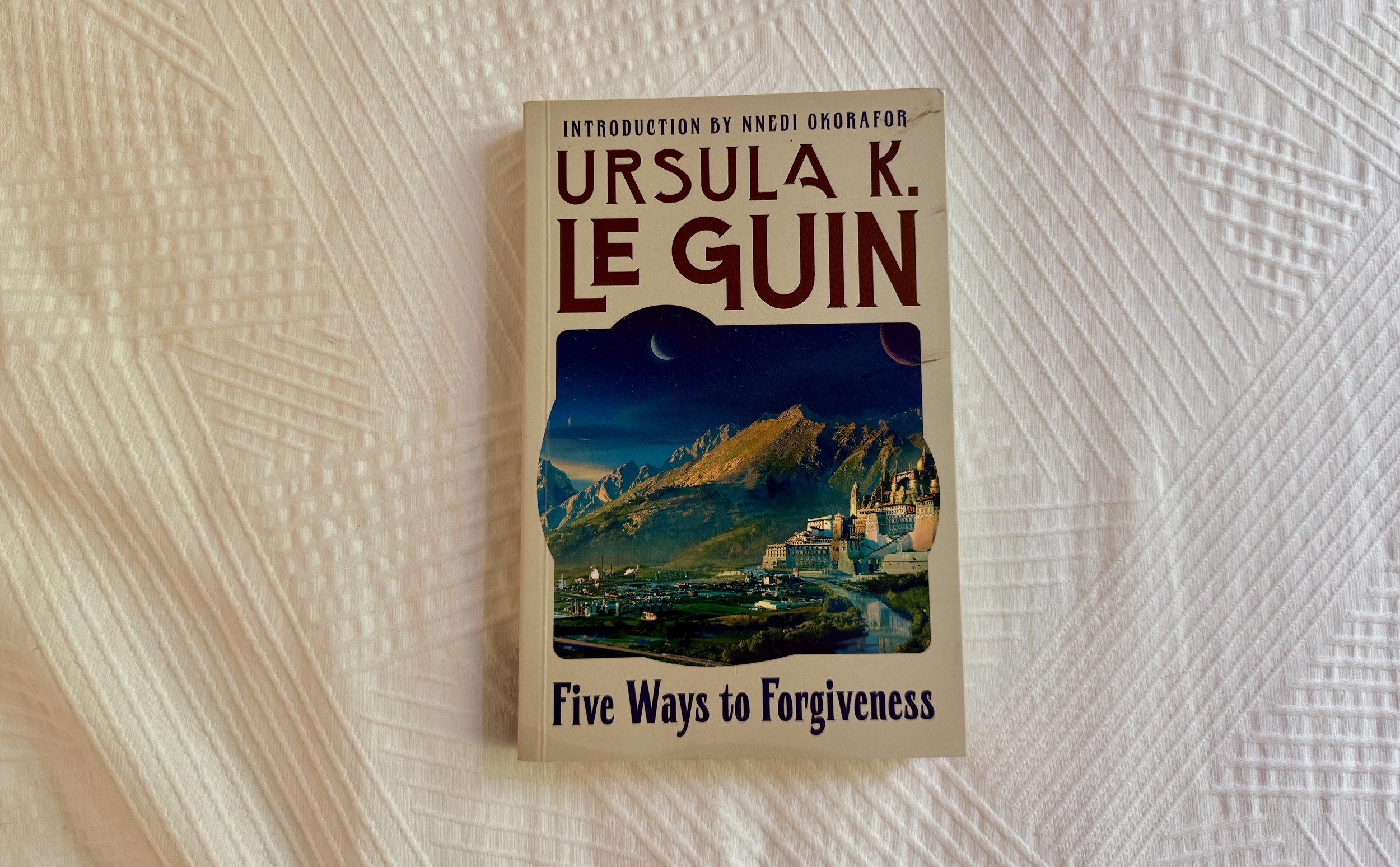
Last week I finished re-reading Five Ways To Forgiveness, which is a series of her short stories set on two worlds that are on the verge of joining a greater league of worlds.
These two worlds are in the midst or recovering from an enormous period of social upheaval, one that dramatically shifted the power structures and society. In general, this is for the better. The stories, though, are about just how long it takes for this change to happen, and how hard that necessary change can be.
Go and read this book (and the stories within) to experience them for the first time. And then read them again.
That’s it for this edition of Ley Lines. Thanks for reading. Or you’re welcome for the content.
If you liked this then let me know - drop me a line here on the site or leave a comment here on the post.

Hockey masks, history, and literature.