
“How much should I charge for strategy?”
Last year Cassio Campos and I started Debrief Cafe, an informal organization that promotes monthly meet-ups for strategists in cities across Canada. As part of that, we have a WhatsApp group that has some great discussions.
One of the questions that I’ve seen pop up in the chat, in my DMs, and generally online is how much people should be charging for strategy work.
I’ve kicked a few answers around here and there, and thought it was about time I wrote something down about it rather than re-hashing answer each time.
And this is my blog, so I’m allowed to toot my own horn a little bit:
Over the past few years I’ve gotten really good at scoping projects.
A lot of that comes down to experience. I spent a few years learning from some incredible Project Managers and Suits at DDB around the world on both new business and yearly retainer scopes of work. Following that, I spent years freelancing and having to scope my own projects on a huge range of topics: brand strategy, digital strategy, new business pitching.
At Major Tom, where I spent almost 4 years, we spent a lot of time pitching. And that meant a lot of time scoping everything from huge website projects, yearly retainers for paid media management, right down to small consulting and brand strategy projects.
I also like scoping.
Maybe I just like spreadsheets, though. After days of receiving increasingly workslopped emails or meetings with no clear outcomes it’s nice to see formulas and work and numbers click into place.
And I also like helping other people out.
So when someone asks me “how much should I charge for strategy work?” I tend to get a bit excited.
This Blog Post Is Not For You If You Think You Know What You’re Doing
You know who you are: You work at agency and have a different type of tool for scoping projects that accounts for agency profitability
Or you’ve also been doing this for years, and have your own system that works for you.
No, this blog post and system isn’t for you.
It’s for the people who are just starting out, or who haven’t cracked a way of scoping that works for them.
It’s for the people who have been doing this for a while, and are interested in looking at it differently.
It’s a place for them to start, and to adapt to their own purposes.
Time vs Value
There is this age-old debate in the world of agencies about whether you should be charging for “time” (the hours your team puts in) vs “value” (how much the project or work is worth to the client at the end of the day).
On the left-right spectrum of economics I am closer to the left than I am the centre. I believe that we should all make a bit more money for the work that we do, and that we should pay a decent chunk of that towards initiatives that make a better world for everyone. I also think companies should make a little bit less money, and be taxed more. But that’s a bigger conversation than what this particularly blog is about.
However, we do still have to talk about this time vs value equation.
The first thing to remember is that your time is valuable. And, in the world we live in, it is also very likely that your bills come in on a monthly basis. Your rent or mortgage isn’t based on how much value you’ve gotten out of your home that month. Your calorie requirements are generally on a daily basis, though not a per project basis.
So you therefore need to figure out a way to get paid that at least accounts for your time.
But that doesn’t mean you have to get paid the bare minimum
The second thing is that not all deliverables are equal. A brand strategy put together by a fresh-faced recent grad in their first year of work might take 100 hours to do and is still a brand strategy but in no way equal to the one that the grizzled 20-year industry veteran banged out in a day. Assuming that both are equally good is ridiculous. So is charging equally for both of them.
Which is what leads us to the value question: One of these is clearly more valuable than the other, but how and why?
In some cases, this is remarkably easy to prove after the fact: a website audit and improved checkout flow that results in more conversions. A recommendation to the creative that improves sales. A business pitch that wins.
In most cases, it is insanely difficult to prove even after the fact. Agencies spend huge amounts of resources to write (and falsify) award entries trying to painstakingly and scientifically make the case that the work worked. On LinkedIn, there is no end to the amount of hand wringing and verbal whinging about “marketing effectiveness” and how to measure it.
In all cases it is impossible to prove before anything has been done. Strategy is always a bit of guesswork and theory.
And in the case of you, the freelancer eking out an existence in the hardscrabble world of working project to project basis, you don’t have the time or capacity to make that case.
It’s also unlikely that you’re responsible for the actual execution of the strategy, nor will you be around long enough to see the results of it’s implementation. That’s the job of your clients, and that’s why they have salaries and bonuses.
Clients won’t sign off on “potential value” or “potential ROI.”
You should have a good idea of how much your time is worth, based on your level of expertise and what the market will take. That’s the “value” part of the equation.
That’s your starting point.
EDIT: I posted a link to this thing on LinkedIn and got a really great comment from Dennis Stam:
“From what I’ve learned so far; get an introduction meeting to understand the problem and the value of that problem solved. Package 3 solutions priced at 10, 15, 25% of that value and package in terms of solving the problem together, by yourself and with or without follow-up check-ins after the problem is solved.”
I really like that approach…but, I don’t think it’s one size fits all. The approach I’m recommending here is for those smaller-scale accounts or for areas where the actual value harder to determine for a lot of reasons. Many organizations don’t know the value of the solve they’re looking for, and either don’t see the full value of the solution OR they see the full value of the solution as so large there is no way they’d pay an independent contractor the 10 or 15% to solve it.
What’s The Budget?
Life would be a lot easier if clients shared their budget up front.
Sometimes it’s because they think they are playing the ancient game of negotiation. And they’re playing because they either perversely love it or because they think they need to.
Sometimes it’s simply that they just don’t know the budget. It’s annoying, but sorry - That’s life, and I’m not here to fix it.
In those cases (assuming you want the work), all you can do is put your best foot forward in terms of what you think the right price for that work is.
If they like you and your price, you’ll get the work.
If they like you, but not the price, they’ll let you know. Never discount. You’re better than that. Just reduce the scope of the work to fit their budget.
If they don’t like you, it doesn’t matter what the price is.
How you put that price forward is up to you. It could be one email response with a number, to see if it fits their budget.
Or you could spend three weeks in meetings, having coffee, asking questions, and talking about everything BUT the budget in order to build rapport and confidence.
The right approach is probably something between those two.
Working Backwards
All good strategy starts with the end in sight: What’s the goal? What do we want to achieve? And then figuring out how to get there.
Pricing out a strategy project is the same.
Sometimes clients will have a super clear idea of what they want, and it’s partly your job to make sure you understand what they want.
A lot of times they don’t have a clear idea of what they want. Strategy as a term is vague and misunderstood by even most strategists. This isn’t to say that it’s oh-so-complicated and only someone as brilliant as us, Capital-S Strategists, can wrap their heads around. All I mean is that everyone has a different idea of what it means.
So spend some time thinking through what the client is actually asking for, and ask yourself if that’s what they actually need. Then check in with them, and say “Hey - it sounds like what you’re asking for is this. What that means to me is that I’ll deliver something that looks like this.” and you present them with a very clear description or outline of what that is.
Once you’ve arrived at this point, mutually with your client, you can begin the backwards shuffle to figure out how to get there.
Break it into small chunks with phases, each with a separate set of tasks and deliverables. Each one serves as a check-in point with the client.
In a month-long sprint this might look like a workshop (with associated prep time), stakeholder interviews, desktop research, discovery findings presentation (again, with associated time to build it), and then the strategy development (with a few pieces associated with that) and weekly meetings.
In a longer engagement, this might look like bigger monthly meetings, quarterly-deep dives, and more of the associated time to build deliverables and manage the admin side of booking so many meetings or resources.
The Scoping Workbook
Almost 15 years ago a Project Manager I was working with asked me to help him scope a new client ask. He pulled up a spreadsheet and asked me how much time I’d need for various parts I’d be delivering for the social media side of a relatively big digital strategy.
My mind was blown. I had no idea this was how things were done. People had always just given me hours to work on things, told me how much time I had and that I shouldn’t go over, and which I promptly forgot as soon as I started the project.
This spreadsheet, and the process to build it, changed the way I looked at my work and the business side of the biz.
Since then, I’ve refined it a little bit. I’ve made it easier to use.
But I’ve never actually formalized the template until now.
For some stupid reason, I rebuild it from scratch every single time I start a new project. I’ll probably start using this cleaner template that I built. But I know I’ll also miss that zen that comes from rebuilding a spreadsheet you’ve build a hundred times.
So here’s the quick walkthrough of the sheet:
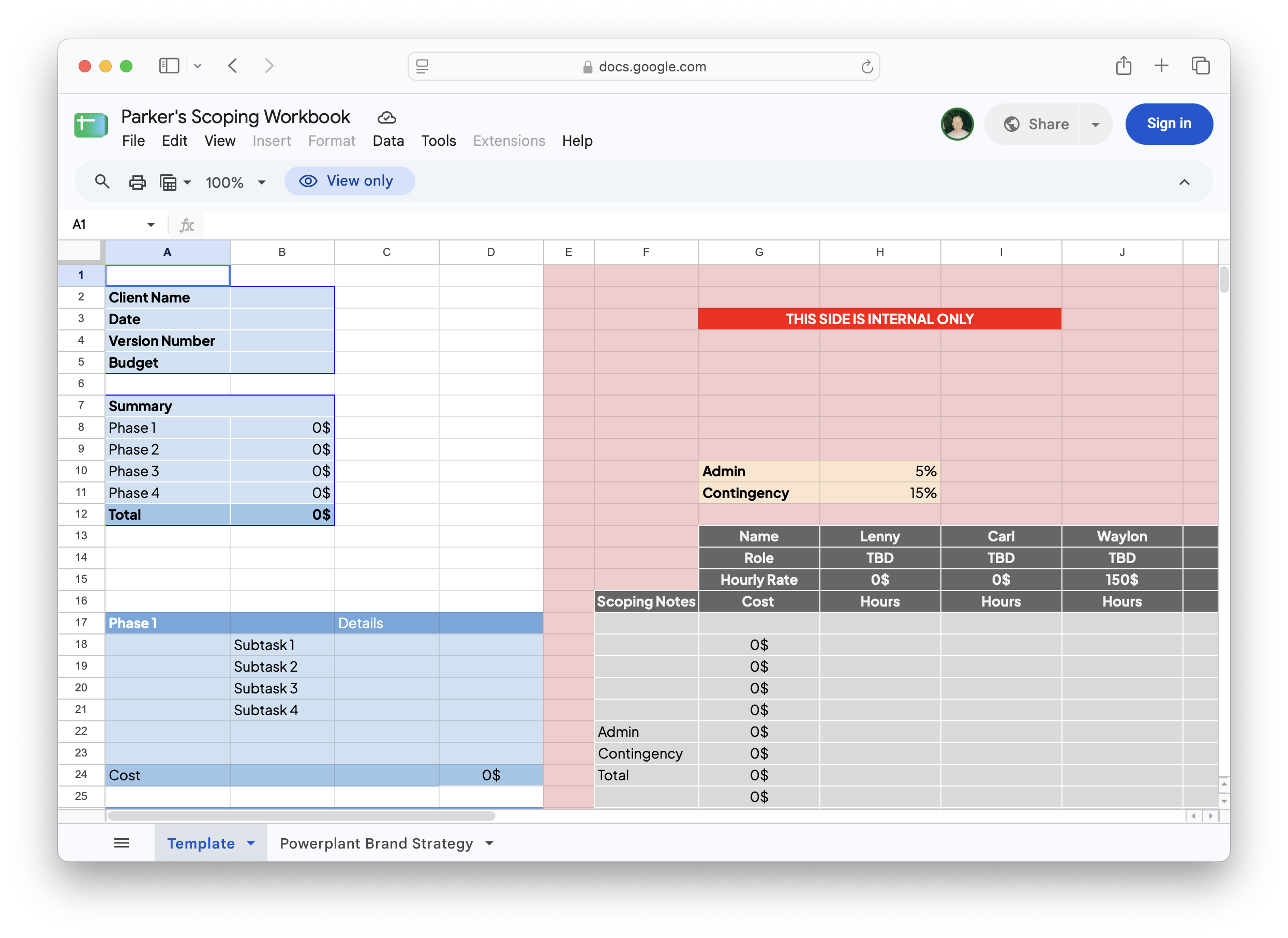
Think you’re a hotshot and don’t need the walk through? Then jump right in.
Right Side vs Left Side: The left side is what you should share with the client. It makes it easy to keep your story straight, to copy and paste into other documents (like a Google Slide or another type of doc) and have any changes reflected across both.
The right side is your workbook. It has all the granular details of your hours, and admin costs. There is nothing to HIDE from clients here. But there is also nothing to gain by showing them. It inevitably ends up with them asking questions like “8 hours to build a presentation after discovery? That seems like a lot. Can’t we just have a meeting?” because they might not realize that the deck building is the thinking.
The Summary is a summary of the phases and totals. This really just makes it easy to refer to at a glance at the top of the page. If my formulas are set up properly, it should update automatically.
Phases, Subtasks, and Details: Each phase should end with a deliverable. The last subtask of each Phase should be presentation or delivery of that deliverable, and the details should spell out a little bit information about what happens for each of those subtasks. If you’re interviewing customers, call out how many here and who is responsible for sourcing them. If you’re researching competitors, make it clear who provides the list and how many there are there.
The Internal (Right) side: This should be pretty self-explanatory. Put the team’s names and roles in, add their hourly rate, then think through how many hours they need for each subtask.
Admin: The work is the work, and sometimes you need a bit more to get things done if there are a lot of meetings, tracking down documents, internal briefings, that sort of thing. You can sometimes cover this as subtasks, or it can be covered under one person’s role if they are the dedicated account person. If you’re solo, like a lot of you probably are, give yourself some admin time.
Contingency: Things happen. Projects go over time. Your computer crashes. The client adds another meeting, or another round of revisions. Having contingency keeps you covered in these cases. It keeps you cool. And if these things don’t happen, you come out slightly more profitable.
You can check out the template here.
Putting Into Practice
Someone I know recently asked me how to scope a large, complex strategy project, and that’s what prompted me putting together this blog post and the scoping workbook.
The general gist of their ask was that their client needed them to develop an Ideal Customer Profile, Brand Positioning, and Content Pillars…as well as probably a lot of other things to support that.
Here’s how I’d approach this:
Define what the client means by all of these, and then use your strategic know-how (along with a little planning derring-do) to make sure that’s all they actually need. If not, suggest what other elements they might need. Persona work? Tone of Voice? Do you need to bring other people like writers or designers in to support you?
Figure out what the sequence that these things need to be done in. And figure out what needs to be done before them. In our sequence here, Ideal Customer Profile likely comes first (though there is a strong argument that Brand Positioning could come first…though it really just gets us into a chicken-egg situation). Think about what steps (or subtasks) you might need to take to build out that ICP. For example:
Review existing audience/customer research
Interviews with Sales and Marketing teams
Customer interviews
Competitive review
Additional desktop research (this used to mean looking around on those weird old forums that all used the same software, and was pretty much one of the best parts of the job.)
Once you’ve done all that, you probably need to wrap it up with a neat little bow in the form of a presentation. That takes time and effort also, and is likely the end of the first phase.
Boom. You’ve got a nice little scope of work that you can defend. If you need to bring the cost down, cut deliverables not your own hours.
Sharing Is Good
There is a school of thought that says we shouldn’t share resources like this. I think that’s a load of garbage.
Being a strategist is my job, and the more that I can help other strategists get paid what they’re worth, the more likely it will be that I’m paid what I’m worth.
If this helps you out then let me know.
If you think of something that would make it better, then also let me know. We can help each other out.
One Last Thing: Believe In Yourself
When all is scoped and done and ready for signing, you need to believe in yourself.
I don’t mean that in some modern, feel-good way that will leave you singing and smiling.
What I mean is that if you don’t believe that the work you’re putting in front of a client will deliver the value you’re charging then at best you’re likely committing fraud, and at worst you’re making the entire industry and profession look bad.
Believe, in the way built on rational thought and your own experience, that what you’re putting in front of your client is representative of the value you and your own skills bring and you’ll be able to confidently defend any questions on the scope.